Black History Month 2021 at Ferncliff
In honor of Black History Month, we are paying homage to some of the influential Black Ohioans who are interred at Ferncliff Cemetery. To learn more about Black History Month, visit The Association for the Study of African American Life and History’s website.
Civil Rights Activists
Dorothy Evans Bacon Feb. 1912 – Nov. 6, 1984
Jerome J. S. Bacon March 1903 – Jan. 23, 1987
The story of Dorothy and Jerome (Jerry) Bacon, their ancestors and descendants and their role in the history of Springfield, is an amazing story of resilience and fortitude.
Dorothy was born in 1912 to Blanche and William Evans on a farm outside of town. After her mother remarried, when Dorothy was just an infant, they moved to West Grand Avenue.
In the late 20’s she married Jerome Jerette Sunnyfield Bacon, an apprentice to Joe Mitchell’s Cleaners, who played trumpet nightly in Professor Vaughn’s Springfield Brass Band.
Following the Depression, when the family had moved to Columbus to find work with the WPA, Dorothy and Jerry moved back to Springfield following the war where Jerry went to work at International Harvester and Dorothy got involved in the emerging movement for civil rights.
With his savings from International Harvester, Jerry opened his own business, Bacon’s Cleaning. Dorothy began to fight the segregation and injustice she saw in her community and became secretary of the NAACP, and Democratic committeewoman in her precinct. She fought for the desegregation of schools and helped Perrin Woods Elementary become the first desegregated school in Springfield.
Leaders in the early struggle to break the town’s color line, Dorothy and Jerry are buried here in Ferncliff in Section 28. The Bacon family was one of five local families featured in Newsweek magazine’s 50th anniversary issue published in Spring 1983.
We invite you to read the entire Spring 1983 anniversary issue of Newsweek recounting the history of Springfield and of our country in the telling of the stories of the Bacon, Cappelli, Nuss, Bayley and Gram families.

Ohio's First Black Mayor
Robert C. Henry July 16, 1921 – Sept. 8, 1981
Robert Clayton Henry was born in Springfield, one of twelve children. After attending Wittenberg University, he went to the Cleveland College of Mortuary Science for his degree in mortuary studies.
In 1951 he founded the Robert C. Henry Funeral Home. Apart from his mortuary business, Robert was active in charitable causes and civic organizations.
In 1961 he was elected to his first political post as Springfield City Commissioner. Four years later, the commission appointed him Mayor. Upon his installation as mayor in 1966, Robert Henry was recognized as the first Black Mayor in Ohio and the first Black Mayor of a city the size of Springfield (82,000 according to the 1960 census) in the United States.
In 1968 he declined to run for re-election but remained on the commission. Robert remained active in political, civic, and charitable endeavors until his death from cancer in 1981. The main fountain in Fountain Square in downtown, as well as a retirement home, bear his name. Upon his death in 1981, Robert C. Henry was entombed Ferncliff’s Mausoleum 1.

Sports Icons from Springfield
Brooks Lawrence Jan. 31, 1925 – Apr. 27, 2000 Sect. WWII Annex
Brooks was known as one of Springfield’s baseball greats. Attending Keifer Jr. High and Springfield South, he excelled in sports including track, basketball, and football. During WWII, Brooks served in the Army on Guam where he was awarded the Bronze Star.
After the war, he enrolled in 1947 at Miami University where he played on the baseball team. After several years in the minor leagues, he was called up to the St. Louis Cardinals in 1954. He was traded to the Cincinnati Reds in 1955 (during the brief time when they were called the Redlegs) where he was selected to the National All-Star team and ended as the top pitcher in the club. After his retirement from baseball, Brooks worked at International Harvester for 10 years.
He then spent 10 years in the front office of the Cincinnati Reds, being the first minority hire to handle scouting, minor-league development, radio and television work, and season ticket sales. Brooks Lawrence died on April 27, 2000 and is interred in Ferncliff’s WWII Annex in the Veterans Section.

Davey Moore 1933 – March 25, 1963 Sect. Y
Davey Moore made his professional debut in the boxing world at age 20, winning 22 of his first 27 fights. Prior to his turning pro, in 1952 he was selected to the US Olympic team in Helsinki, Finland.
His professional boxing career took him to France, Spain, Italy, Venezuela and many other countries. In 1957 he became the World Featherweight Champion, defeating Hogan Kid Bassey in a 13th round knockout. He held this title until his death on March 25, 1963.
In a televised title match against Sugar Ramos in Los Angeles on March 21, he collapsed in the 10th round. He went into a coma and died a few days later. His unexpected death shocked the world and Bob Dylan wrote a song in his honor, “Who Killed Davey Moore?”
Returned to Springfield for burial in Ferncliff in Section Y, thousands of mourners attended Davey’s service.

Underground Railroad Agents
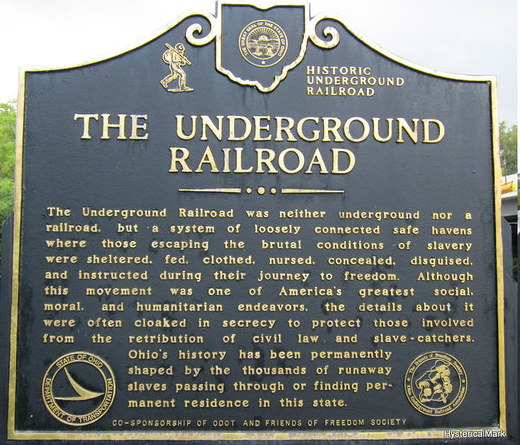
Springfield and its residents played an active part in the operation of The Underground Railroad (UGRR) in the early to mid-1800’s. The scarcity of formal records is explained by the secrecy of the UGRR.
With the passage of the Fugitive Slave Law in 1850 it was a federal crime to harbor runaway slaves. The UGRR was a model of cooperation between all anti-slavery segments within the community. All races, religions and social classes worked extremely well together with no reported captures in the Springfield area.
Many members of the Black community in Springfield were heavily involved in the activities of the UGRR, including the Nutter, Bell, Piles, Gammon, Thomas and Durgans families.
George Gammon 1803 – 1904
Sarah “Sallie” (Bradley) Gammon 1808 – 1902
George and Sarah Gammon were activists in the Underground Railroad and owners of the Gammon House, a noted safe house. The Gammon House is one of the few existing safe houses in Ohio and the country, that was owned by free people of color.
George was a sawyer, or carpenter. Sarah was remembered to have fed and clothed runaways in their home, waiting for pick-up and transport northwards to Urbana and Marysville.
George and Sarah Gammon are interred in Section F of Ferncliff Cemetery.
George Durgans 1816 –1882
George Durgans was a local activist in the Underground Railroad. Mr. Durgans may have also been referred to as Durgan or Durgin. The Springfield Daily Republic newspaper of Feb. 19, 1882: “Another well-known colored citizen, Mr. George Durgin, passed away… at the home of his brother, Mr. Griffith Eglar on South Center St. Deceased was about 65 years of age, and came here from Bourbon County, Kentucky, about the close of the war. He was very portly and dignified in demeanor. First at the Murray (now St. James) and since its erection, at the Lagonda House, he has been on duty as head porter, runner at depot, etc., and had a very wide acquaintance among traveling men…”
George Durgans is buried in section F at Ferncliff Cemetery.
Robert J. Piles 1814 – 1886
Robert Piles was a barber and a well-known resident of Springfield, Ohio. One of the first members of the UGRR, he was active in the community. One of his sons, James H. (born 1839) graduated from Oberlin College and returned to Springfield to practice law, being one of the earliest Black men to be admitted to the Clark County Bar.
James became politically active at both the state and national levels. As a boy, James and his brother, Joseph, both assisted in their father’s barbering business. Each of these families worked together to help ensure the success of the UGRR.
Meetings and trains ran from the Gammon House northward. News of “slavecatchers” in the area was passed between the hotel and barbershop to the train masters for scheduling purposes. The Gammon House stands a symbol of freedom and humanity of which Springfield and Clark County can be proud. Robert J. Piles is interred in section B of Ferncliff Cemetery.
To learn more about Black History Month, visit The Association for the Study of African American Life and History’s website.